I believe each individual is responsible for taking care of ourselves, physically and mentally in the best way possible for our own good and the good of those around us.
A person with a severe peanut allergy is ultimately responsible for getting the treatment they need, carrying an epi pen, and managing their triggers. But sometimes that sneaky peanut exposure breaks through.
What if people treated physical illness like so many treat mental illness? Imagine this with me…. Someone at the grocery store accepts a bite of a delicious looking desert from “the sample lady”. They ask if there are any nuts in it and are told, erroneously, no. The shopper takes a bite of the treat and next thing you know she begins coughing, panicking, turning beet red, and collapses to the floor.
What if the people around instead of trying to help said, “Oh, she’s faking it. Allergies are all in your head.”, “Kids, let’s get away from here – that woman’s crazy. Her hand hit one of you as she fell – it’s not safe to be around her”, or “It’s her own fault for taking the sample. Let’s just let her face the consequences”.
I’m exhausted right now from dealing with some recent triggers of my own. So I will leave it right there.
But please join me in trying to spread some understanding….
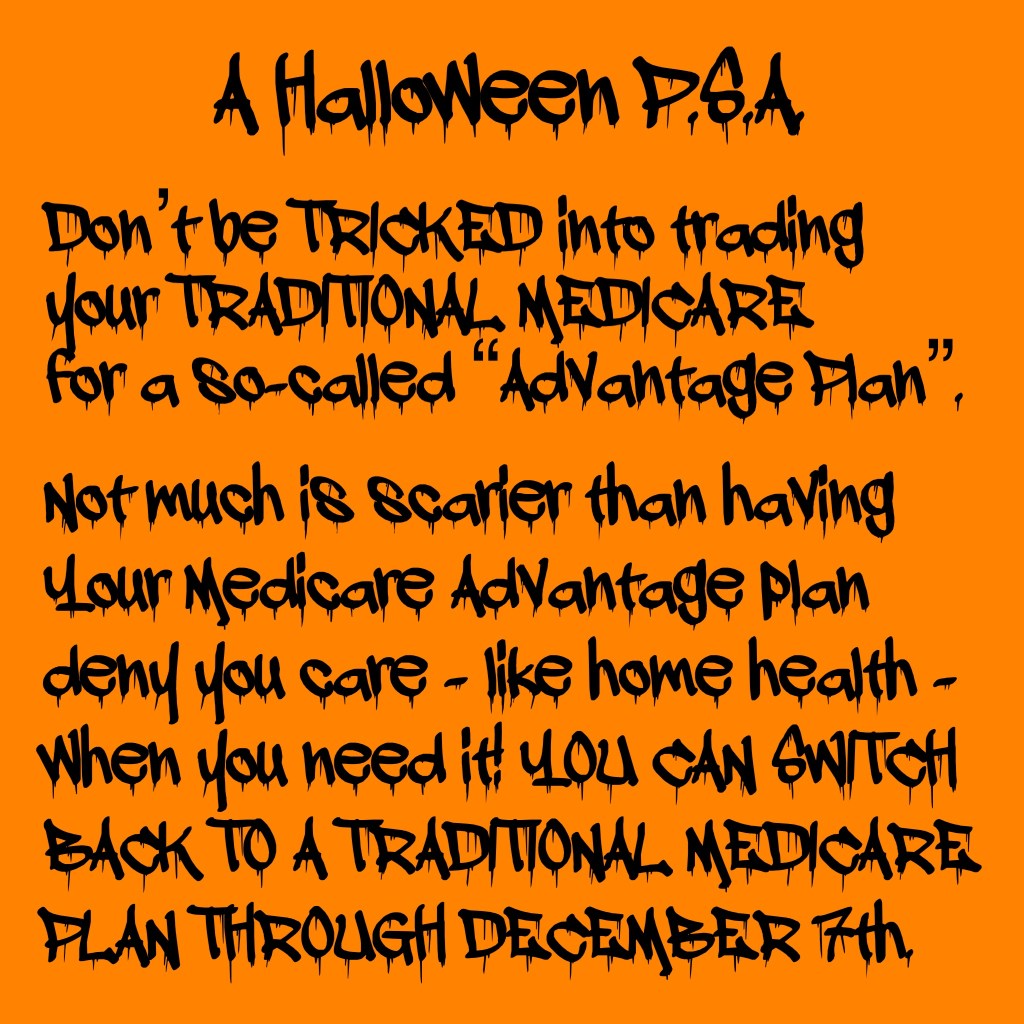
It’s open enrollment season. Every other commercial asks us to trade in our traditional Medicare for Replacement Plans. The incentives include gym memberships, rides to appointments, and online health coaching.
Left unspoken are things these plans don’t cover very well. I have seen many patients face significant care challenges and financial difficulty because the plans they chose don’t provide what they need when facing more chronic or serious health challenges. (Things that are much pricier than rides and gym memberships). It’s heartbreaking. But I am also praying it is avoidable with a bit of education such as what I offer here.
Did you know that traditional Medicare covers as many home health visits as your medical team submits that you need at 100%? Managed care plans focus on preventative and outpatient care and dictate a minimal number of visits while Medicare Part A and/or Part B cover home health services when you are homebound during a major illness or after a surgery at no additional out-of-pocket cost to you.
If you (or your insurance client) are in perfect health needing only preventative care, it makes sense to go for the lower premium and the gym perks. But if, like many of us, you are fighting multiple chronic illness or anticipate some at-home recovery time after having some well-used joints replaced, please don’t let anyone talk you into giving up your traditional Medicare (Medicare Parts A and B) without doing your homework. From Medicare.gov to local Senior Centers, there are so many resources.
Please take the time to do your research homework based on your specific needs. “Future you” will thank you for a careful decision during Medicare open enrollment season.
Over 30 years ago, as a brand-new graduate nurse, I was starry-eyed and ready to change the world – one patient’s life at a time.
Over time, I discovered that my passion to make a difference paired with my ability to communicate and connect with others could work well in other avenues of healthcare such as quality, patient safety, and regulatory.
I wanted to facilitate processes that made it as easy as possible for every healthcare professional to do the right thing for every single patient every single time.
However, sometimes the best intentions may backfire and may even make it more difficult for the patient care frontline to do their jobs – particularly if initiatives outlive the problem they were designed to solve.
Let me explain, pre-pandemic there were more nurses and more time for them to participate in performance improvement projects and influence the practice changes that impacted their every day. Checklists and audits created healthy reminders of steps toward best evidenced-based practice.
But then the whole world, and in particular our healthcare world, was changed by that invisible-to-the-naked-eye enemy. COVID-19. We were already on shaky ground with new nurses not being educated quickly enough to replace retiring ones and high rates of burnout during the best of times. But now as many as 1 in 5 fulltime healthcare professionals are leaving those roles. Suicide rates among healthcare professionals – which were never low – are now higher than ever.
So, actions like asking a charge nurse to complete daily audits or pulling a nurse manager into multiple performance improvement actives may have worked a few years ago. But asking those same things now when charge nurses and managers are often pulled into staffing with full patient loads doesn’t feel like supporting them anymore.
I absolutely know that processes in healthcare need to be checked and audited. But I also know that throwing one more thing on already stretched – sometimes traumatized even – healthcare team members can be that “final straw” that causes them to call it quits.
For me, personally, I am coming full circle in my career and actually taking a career break in order to regroup and find ways to wear scrubs more and carry “corrective clipboards” less. (Plus, this break coincides will with my taking some long overdue time for some healing and processing of a couple strong blows that have hit my personal life hard in recent years). I know not everyone has the ability to do this, but I believe there are some things everyone in healthcare leadership can easily do to be a blessing-not-a-burden, asset-not-an-a$$-kicker, supporter-not-a-destroyer, and an encourager-not-an-enforcer. (You get the idea).
Wear scrubs
Sometimes it’s as simple as losing the polyester power suit or dress and being a little more relatable
Jump in and do something tangible for them!
You may be like me and it’s been a minute since your clinical days. It may not be safe for you to take a whole load of patients. But if you’re more on the administrative side of health care these days, even taken 10-15 minutes out of your day to answer phones or call lights or calm a confused patients could make the difference and make you much easier to listen to when you give them correction or advice.
Uplift more than you correct.
Remember when all the leadership gurus were touting the importance of sandwiching correction or any other information that may weigh someone down between positive/uplifting comments? Well, that is more important than ever!
Just being present and listening can mean more than you ever know. Now more than ever, healthcare professionals may feel warn and torn – like a ragamuffin. If they see your heart, time, and intention – you may be just the oasis a weary soul needs.
Walter Cronkite made this statement decades ago, long before COVID-19, the hyper-politicization of healthcare, supply crises, and staffing shortages like we’ve never seen before. So… the truth of these words rings even more loudly today.
However, I believe the current tipping point of my industry is birthing the #innovative “out of the box” thinking so necessary for much needed positive and lasting #change.
And, by “out of the box”, I truly mean out of big boxy hospital buildings and through screens into homes, thanks to innovative uses of #telemedicine.
As lauded at the beginning of the pandemic, healthcare professionals truly are amazing, caring superheroes. However, even the greatest superheroes cannot sustain changes in a broken system.
Praying that all of these crises will facilitate the mending of our country’s healthcare system rather than accelerating its implosion.




 Ragamuffin Oasis: Finding Our Places to Just Be